 Add to Chrome
 Add to Firefox
 Add to Edge
OmniThoughtVis: A Scalable Distillation Pipeline for Deployable Multimodal Reasoning Models
May 12, 2026
Recent multimodal large language models (MLLMs) have shown strong chain-of-thought (CoT) reasoning ability on vision-language tasks, but their direct deployment in real-world systems is often limited by latency and resource constraints. In practice, smaller MLLMs are preferred for online serving, yet their reasoning performance is bottlenecked by the lack of large-scale, high-quality multimodal CoT supervision. In this paper, we present OmniThoughtVis, a scalable data curation and distillation pipeline for transferring multimodal reasoning capabilities from high-capacity teacher models to smaller, deployment-oriented MLLMs. Starting from a diverse open-source seed pool, our pipeline generates structured CoT traces and performs joint annotation of reasoning difficulty, answer quality, and semantic task tags. To maintain data quality at scale, we combine rule-based filtering, difficulty-aware selection, and tag-based diversity sampling, resulting in a curated corpus of 1.8M samples that supports controllable subset construction for downstream training. We use OmniThoughtVis to distill Qwen3-VL models from 2B to 8B parameters and evaluate them on nine multimodal reasoning benchmarks. The resulting distilled models show consistent gains across model scales, including improvements of up to +16.8 points on MathVerse and +5.6 points on MMMU-Pro for the 4B model. Notably, the distilled 4B model matches or surpasses the undistilled 8B baseline on several tasks, highlighting the practical value of scalable reasoning distillation for deployment-oriented MLLMs.

AgenticQwen: Training Small Agentic Language Models with Dual Data Flywheels for Industrial-Scale Tool Use
Apr 23, 2026Modern industrial applications increasingly demand language models that act as agents, capable of multi-step reasoning and tool use in real-world settings. These tasks are typically performed under strict cost and latency constraints, making small agentic models highly desirable. In this paper, we introduce the AgenticQwen family of models, trained via multi-round reinforcement learning (RL) on synthetic data and a limited amount of open-source data. Our training framework combines reasoning RL and agentic RL with dual data flywheels that automatically generate increasingly challenging tasks. The reasoning flywheel increases task difficulty by learning from errors, while the agentic flywheel expands linear workflows into multi-branch behavior trees that better reflect the decision complexity of real-world applications. We validate AgenticQwen on public benchmarks and in an industrial agent system. The models achieve strong performance on multiple agentic benchmarks, and in our industrial agent system, close the gap with much larger models on search and data analysis tasks. Model checkpoints and part of the synthetic data: https://huggingface.co/collections/alibaba-pai/agenticqwen. Data synthesis and RL training code: https://github.com/haruhi-sudo/data_synth_and_rl. The data synthesis pipeline is also integrated into EasyDistill: https://github.com/modelscope/easydistill.
Mock Worlds, Real Skills: Building Small Agentic Language Models with Synthetic Tasks, Simulated Environments, and Rubric-Based Rewards
Jan 30, 2026Small LLMs often struggle to match the agentic capabilities of large, costly models. While reinforcement learning can help, progress has been limited by two structural bottlenecks: existing open-source agentic training data are narrow in task variety and easily solved; real-world APIs lack diversity and are unstable for large-scale reinforcement learning rollout processes. We address these challenges with SYNTHAGENT, a framework that jointly synthesizes diverse tool-use training data and simulates complete environments. Specifically, a strong teacher model creates novel tasks and tool ecosystems, then rewrites them into intentionally underspecified instructions. This compels agents to actively query users for missing details. When handling synthetic tasks, an LLM-based user simulator provides user-private information, while a mock tool system delivers stable tool responses. For rewards, task-level rubrics are constructed based on required subgoals, user-agent interactions, and forbidden behaviors. Across 14 challenging datasets in math, search, and tool use, models trained on our synthetic data achieve substantial gains, with small models outperforming larger baselines.
VTC-R1: Vision-Text Compression for Efficient Long-Context Reasoning
Jan 29, 2026Long-context reasoning has significantly empowered large language models (LLMs) to tackle complex tasks, yet it introduces severe efficiency bottlenecks due to the computational complexity. Existing efficient approaches often rely on complex additional training or external models for compression, which limits scalability and discards critical fine-grained information. In this paper, we propose VTC-R1, a new efficient reasoning paradigm that integrates vision-text compression into the reasoning process. Instead of processing lengthy textual traces, VTC-R1 renders intermediate reasoning segments into compact images, which are iteratively fed back into vision-language models as "optical memory." We construct a training dataset based on OpenR1-Math-220K achieving 3.4x token compression and fine-tune representative VLMs-Glyph and Qwen3-VL. Extensive experiments on benchmarks such as MATH500, AIME25, AMC23 and GPQA-D demonstrate that VTC-R1 consistently outperforms standard long-context reasoning. Furthermore, our approach significantly improves inference efficiency, achieving 2.7x speedup in end-to-end latency, highlighting its potential as a scalable solution for reasoning-intensive applications. Our code is available at https://github.com/w-yibo/VTC-R1.
An Information-Theoretic Framework for Robust Large Language Model Editing
Dec 18, 2025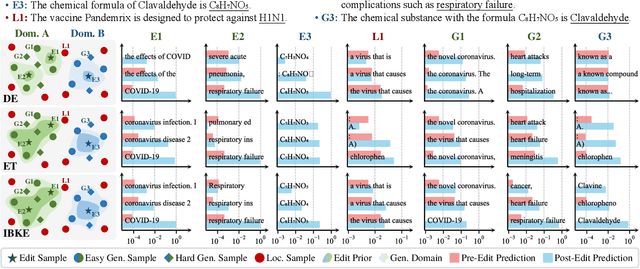
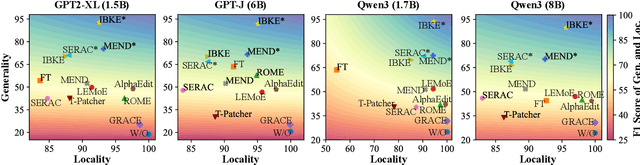
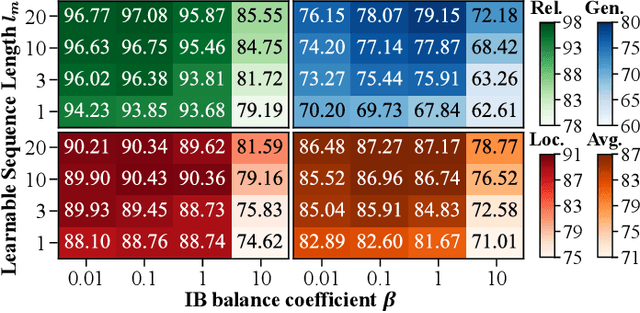

Large Language Models (LLMs) have become indispensable tools in science, technology, and society, enabling transformative advances across diverse fields. However, errors or outdated information within these models can undermine their accuracy and restrict their safe deployment. Developing efficient strategies for updating model knowledge without the expense and disruption of full retraining remains a critical challenge. Current model editing techniques frequently struggle to generalize corrections beyond narrow domains, leading to unintended consequences and limiting their practical impact. Here, we introduce a novel framework for editing LLMs, grounded in information bottleneck theory. This approach precisely compresses and isolates the essential information required for generalizable knowledge correction while minimizing disruption to unrelated model behaviors. Building upon this foundation, we present the Information Bottleneck Knowledge Editor (IBKE), which leverages compact latent representations to guide gradient-based updates, enabling robust and broadly applicable model editing. We validate IBKE's effectiveness across multiple LLM architectures and standard benchmark tasks, demonstrating state-of-the-art accuracy and improved generality and specificity of edits. These findings establish a theoretically principled and practical paradigm for open-domain knowledge editing, advancing the utility and trustworthiness of LLMs in real-world applications.
SPG: Sandwiched Policy Gradient for Masked Diffusion Language Models
Oct 10, 2025Diffusion large language models (dLLMs) are emerging as an efficient alternative to autoregressive models due to their ability to decode multiple tokens in parallel. However, aligning dLLMs with human preferences or task-specific rewards via reinforcement learning (RL) is challenging because their intractable log-likelihood precludes the direct application of standard policy gradient methods. While prior work uses surrogates like the evidence lower bound (ELBO), these one-sided approximations can introduce significant policy gradient bias. To address this, we propose the Sandwiched Policy Gradient (SPG) that leverages both an upper and a lower bound of the true log-likelihood. Experiments show that SPG significantly outperforms baselines based on ELBO or one-step estimation. Specifically, SPG improves the accuracy over state-of-the-art RL methods for dLLMs by 3.6% in GSM8K, 2.6% in MATH500, 18.4% in Countdown and 27.0% in Sudoku.
Zero-to-Hero: Zero-Shot Initialization Empowering Reference-Based Video Appearance Editing
May 29, 2025Appearance editing according to user needs is a pivotal task in video editing. Existing text-guided methods often lead to ambiguities regarding user intentions and restrict fine-grained control over editing specific aspects of objects. To overcome these limitations, this paper introduces a novel approach named {Zero-to-Hero}, which focuses on reference-based video editing that disentangles the editing process into two distinct problems. It achieves this by first editing an anchor frame to satisfy user requirements as a reference image and then consistently propagating its appearance across other frames. We leverage correspondence within the original frames to guide the attention mechanism, which is more robust than previously proposed optical flow or temporal modules in memory-friendly video generative models, especially when dealing with objects exhibiting large motions. It offers a solid ZERO-shot initialization that ensures both accuracy and temporal consistency. However, intervention in the attention mechanism results in compounded imaging degradation with over-saturated colors and unknown blurring issues. Starting from Zero-Stage, our Hero-Stage Holistically learns a conditional generative model for vidEo RestOration. To accurately evaluate the consistency of the appearance, we construct a set of videos with multiple appearances using Blender, enabling a fine-grained and deterministic evaluation. Our method outperforms the best-performing baseline with a PSNR improvement of 2.6 dB. The project page is at https://github.com/Tonniia/Zero2Hero.
EasyDistill: A Comprehensive Toolkit for Effective Knowledge Distillation of Large Language Models
May 27, 2025In this paper, we present EasyDistill, a comprehensive toolkit designed for effective black-box and white-box knowledge distillation (KD) of large language models (LLMs). Our framework offers versatile functionalities, including data synthesis, supervised fine-tuning, ranking optimization, and reinforcement learning techniques specifically tailored for KD scenarios. The toolkit accommodates KD functionalities for both System 1 (fast, intuitive) and System 2 (slow, analytical) models. With its modular design and user-friendly interface, EasyDistill empowers researchers and industry practitioners to seamlessly experiment with and implement state-of-the-art KD strategies for LLMs. In addition, EasyDistill provides a series of robust distilled models and KD-based industrial solutions developed by us, along with the corresponding open-sourced datasets, catering to a variety of use cases. Furthermore, we describe the seamless integration of EasyDistill into Alibaba Cloud's Platform for AI (PAI). Overall, the EasyDistill toolkit makes advanced KD techniques for LLMs more accessible and impactful within the NLP community.
UniEdit: A Unified Knowledge Editing Benchmark for Large Language Models
May 18, 2025Model editing aims to enhance the accuracy and reliability of large language models (LLMs) by efficiently adjusting their internal parameters. Currently, most LLM editing datasets are confined to narrow knowledge domains and cover a limited range of editing evaluation. They often overlook the broad scope of editing demands and the diversity of ripple effects resulting from edits. In this context, we introduce UniEdit, a unified benchmark for LLM editing grounded in open-domain knowledge. First, we construct editing samples by selecting entities from 25 common domains across five major categories, utilizing the extensive triple knowledge available in open-domain knowledge graphs to ensure comprehensive coverage of the knowledge domains. To address the issues of generality and locality in editing, we design an Neighborhood Multi-hop Chain Sampling (NMCS) algorithm to sample subgraphs based on a given knowledge piece to entail comprehensive ripple effects to evaluate. Finally, we employ proprietary LLMs to convert the sampled knowledge subgraphs into natural language text, guaranteeing grammatical accuracy and syntactical diversity. Extensive statistical analysis confirms the scale, comprehensiveness, and diversity of our UniEdit benchmark. We conduct comprehensive experiments across multiple LLMs and editors, analyzing their performance to highlight strengths and weaknesses in editing across open knowledge domains and various evaluation criteria, thereby offering valuable insights for future research endeavors.
BELLE: A Bi-Level Multi-Agent Reasoning Framework for Multi-Hop Question Answering
May 17, 2025Multi-hop question answering (QA) involves finding multiple relevant passages and performing step-by-step reasoning to answer complex questions. Previous works on multi-hop QA employ specific methods from different modeling perspectives based on large language models (LLMs), regardless of the question types. In this paper, we first conduct an in-depth analysis of public multi-hop QA benchmarks, dividing the questions into four types and evaluating five types of cutting-edge methods for multi-hop QA: Chain-of-Thought (CoT), Single-step, Iterative-step, Sub-step, and Adaptive-step. We find that different types of multi-hop questions have varying degrees of sensitivity to different types of methods. Thus, we propose a Bi-levEL muLti-agEnt reasoning (BELLE) framework to address multi-hop QA by specifically focusing on the correspondence between question types and methods, where each type of method is regarded as an ''operator'' by prompting LLMs differently. The first level of BELLE includes multiple agents that debate to obtain an executive plan of combined ''operators'' to address the multi-hop QA task comprehensively. During the debate, in addition to the basic roles of affirmative debater, negative debater, and judge, at the second level, we further leverage fast and slow debaters to monitor whether changes in viewpoints are reasonable. Extensive experiments demonstrate that BELLE significantly outperforms strong baselines in various datasets. Additionally, the model consumption of BELLE is higher cost-effectiveness than that of single models in more complex multi-hop QA scenarios.